Why the Screen and Enclosure Matter as Much as the Launch Monitor
When most people start researching a golf simulator, almost all of the attention goes to the launch monitor. And understandably so — it is the most expensive single component and the piece of technology that drives the entire experience. But here is something we see time and time again: a customer invests heavily in a top-tier launch monitor, then cuts corners on the screen and enclosure.
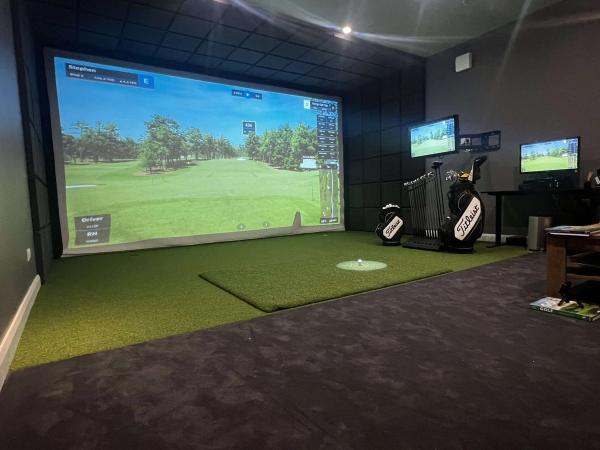
Your impact screen is the surface you hit into thousands of times a year. It is also your projection surface — the thing that turns data into a visual experience. The enclosure is what keeps errant shots contained, protects your walls and ceiling, and gives the whole build a professional, finished feel.
Impact Screens: What They Are and What to Look For
An impact screen is a specialised fabric designed to absorb the energy of a golf ball travelling at speeds of up to 280 km/h, while simultaneously serving as a rear-projection display surface.
Materials
The two most common materials used in quality impact screens are woven polyester and nylon blends. Woven polyester screens tend to be more affordable, offer good durability, and are the standard choice for most home installations.
Key Properties to Evaluate
- Ball return: A good screen absorbs the ball’s energy and drops it straight down, ideally into a tray or onto a mat.
- Image quality: The screen needs to diffuse projected light evenly across its surface without hot spots or excessive light bleed.
- Noise: Every impact screen makes some noise when struck, but better materials dampen the sound significantly.
- Durability: Look for screens rated for a minimum of 20,000 impacts. Quality screens will handle well over 50,000 before showing signs of wear.
Screen Sizes: Finding the Right Fit
Impact screens come in a range of standard sizes, and the right one depends on your room dimensions, projector throw distance, and the overall design of your enclosure.
- 3.0m wide — Suitable for compact rooms and budget builds. Works well in smaller garages and spare rooms where space is tight.
- 3.5m wide — The most popular choice for home installations. Provides a comfortable hitting area with room for a projected image that fills your field of view.
- 4.0m wide — Ideal for dedicated simulator rooms and larger garages. Gives a more immersive experience and accommodates wider projector throws.
- 4.5m wide — Typically used in commercial settings or purpose-built studios. Offers the most immersive visual experience but requires a room width of at least 5 metres.
Height is equally important. Most screens range from 2.5m to 3.0m tall. The key constraint is your ceiling height.
Enclosure Types
The enclosure is the structural framework that holds your screen in place and contains off-target shots. There are several common types.
Basic Frame
A freestanding metal or aluminium frame that supports the screen with bungee cords or a sleeve system. These are the most affordable option and work well for straightforward setups.
Full Cage
A fully enclosed structure with side panels, a ceiling net, and the impact screen at the front. Full cages offer the best protection for your room and are the safest option.
Wall-Mounted
In rooms where floor space is at a premium, a wall-mounted system fixes the screen frame directly to the walls and ceiling. This produces the cleanest look and frees up floor space.
Custom-Built
For unusual room shapes, commercial venues, or clients who want a particular aesthetic, we design and build bespoke enclosures from scratch.
Materials and Build Quality
Not all enclosures are created equal. At the budget end you will find lightweight steel frames with thin netting. Mid-range enclosures typically use powder-coated steel or aluminium with denser netting and better hardware. Premium enclosures are engineered to be rigid, quiet, and visually unobtrusive.
Pay attention to how the screen attaches to the frame. Bungee cord systems allow some give on impact and are easy to adjust. Sleeve systems provide a cleaner look but can be harder to tension correctly.
Budget Ranges
To give you a realistic idea of what to expect, here are the typical budget ranges we see across the Irish market:
- Entry level (€500 – €1,000): A basic frame with a decent impact screen. Suitable for a first build or a tight budget.
- Mid-range (€1,000 – €2,500): A solid enclosure with good-quality screen, side netting, and better hardware. This is where most of our home clients land.
- Premium (€2,500 – €5,000+): Full cage or custom-built enclosures with high-end screens, acoustic considerations, and professional finishing.
Matching Screen and Enclosure to Your Room and Launch Monitor
Your screen and enclosure choices should be driven by three things: the physical space you have, the launch monitor you are using, and how you plan to use the simulator.
Overhead launch monitors like the Uneekor EYE XO or Foresight GCHawk need a clear line of sight from above. Radar-based units like the FlightScope Mevo+ or Garmin Approach R10 sit behind the player and are less affected by enclosure design.
Common Mistakes
- Buying a screen that is too small for the room. A screen that does not fill your field of view breaks the immersion.
- Ignoring side protection. Even good golfers hit the odd shank. Without side netting or panels, one bad shot can put a hole in your plasterboard.
- Choosing the cheapest screen available. Ultra-budget screens bounce balls back dangerously, produce poor image quality, and wear out quickly.
- Not accounting for projector throw distance. Your screen size and projector need to be matched.
- Forgetting about noise. A loud impact screen in a semi-detached house will not make you popular with the neighbours.
Our Recommendation
If you are building a home golf simulator for regular use, we recommend starting with a mid-range enclosure and a quality impact screen — typically in the €1,500 to €2,500 range. This gets you a setup that is safe, durable, looks good, and projects a sharp image.
If you are unsure what size or type of enclosure suits your space, that is exactly what our consultation process is designed to help with.