A Flagship Commercial Build
Every now and then a project comes along that tests every part of what you do. K Golf World was that project for us. It was our largest commercial build to date — a ground-up transformation of an empty commercial unit into a fully operational, six-bay golf entertainment venue. From the first site visit to opening night, the project took just under fourteen weeks and pushed our team to deliver at a level we had not reached before.
This case study walks through the full journey: the brief, the design decisions, the technology choices, the build itself, and the lessons we took away from it. If you are considering a commercial simulator project of any scale, this should give you a clear picture of what is involved.
The Brief
The client behind K Golf World had a clear vision from day one. They wanted to create a premium golf entertainment destination — somewhere between a high-end sports bar and a dedicated golf performance centre. The venue needed to appeal to casual groups looking for a night out, corporate bookings wanting something different, and serious golfers who would use the facility for practice and coaching.
The key requirements we were given:
- A minimum of six simulator bays, each capable of accommodating groups of up to four players
- A lounge and bar area that felt connected to the bays without being on top of them
- Top-tier launch monitor technology — the kind that serious golfers would respect and trust
- A layout that could handle peak-time throughput without bottlenecks at reception or between bays
- An audio-visual setup that would create atmosphere, not just display data
- A build quality that could withstand heavy commercial use, seven days a week
The Space
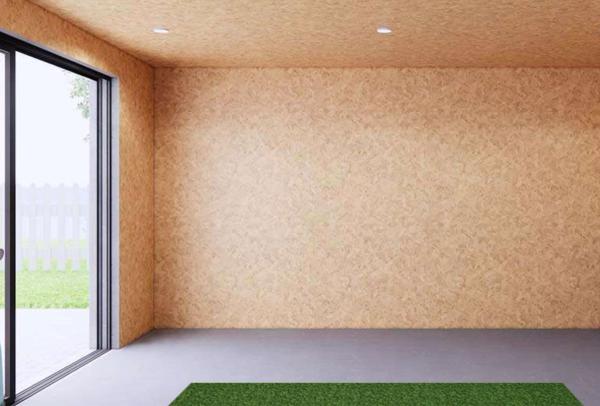
The unit itself was a blank canvas. A rectangular commercial space of approximately 4,800 square feet in a well-located retail and leisure park. High ceilings — just over 3.5 metres at the lowest point — which gave us enough vertical clearance for full swing without worry.
That blankness was both a blessing and a challenge. We did not have to work around existing structures or inherited problems, but it meant every single element — flooring, walls, lighting, HVAC, data cabling, plumbing for the bar area — had to be specified from scratch.
The Design Phase
We spent three weeks in the design phase before any physical work began. That might seem like a long time for a fitout, but for a commercial simulator venue, it is where the project is won or lost.
Bay Layout and Dimensions
Each of the six bays was designed at 4.6 metres wide by 6.1 metres deep. Those dimensions might sound generous, but in a commercial setting, you need that space. Players in a group environment move around more than a solo golfer at home.
Customer Flow
Flow was something we planned with the same rigour as the bays themselves. Customers enter through a reception area that opens into the lounge. From the lounge, they can see into the bays through glazed partitions — this was a deliberate decision to let the activity sell itself.
Lounge and Bar Integration
The lounge area occupies roughly 1,100 square feet of the total footprint. We worked with the client’s interior designer on the furniture and finishes, but we led the acoustic treatment.
Technology Choices
This is where a commercial build diverges sharply from a home installation. At home, you are optimising for one user’s preferences. In a commercial venue, you are optimising for reliability, accuracy, ease of use, and maintainability.
Launch Monitors
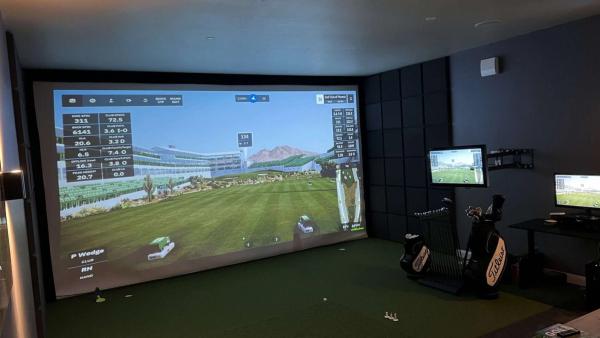
We installed Trackman iO units in all six bays. For a venue that wanted to attract serious golfers alongside casual players, Trackman was the obvious choice. The brand recognition alone carries weight.
Screens and Projection
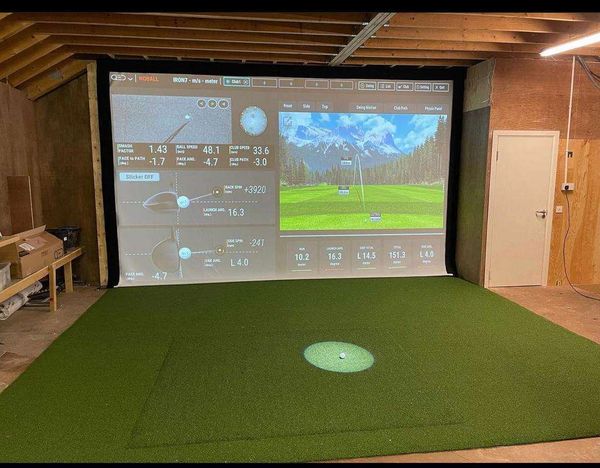
We used commercial-grade Carl’s Place impact screens, custom-sized to fill the full width and height of each bay. Behind each screen, we installed an Optoma short-throw laser projector.
Networking and Infrastructure
Each bay runs on a dedicated hardwired gigabit Ethernet connection back to a central rack in the service corridor. We installed a managed switch with VLAN segmentation.
The Build
Physical work began in week four and ran for ten weeks. The first two weeks were devoted to mechanical and electrical first fix — HVAC ducting, electrical distribution, data cabling, and plumbing for the bar area.
The mid-build challenge came in week six. The flooring subcontractor discovered that the concrete slab had a significant moisture issue in one corner of the unit. The fix added four days to the schedule: we applied a two-coat epoxy moisture barrier, let it cure, and retested before proceeding.
Weeks seven through nine were the most intense — screens went up, projectors were mounted and aligned, Trackman units were installed and calibrated, and all six bays were brought online one at a time.
Week ten was commissioning, snagging, and staff training. We spent two full days with the K Golf World team, walking them through daily maintenance routines, troubleshooting procedures, and the basics of the Trackman software.
Launch and Reception
K Golf World opened on a Thursday evening to an invited audience of around 120 people. All six bays were running simultaneously for the first time with real customers — and everything held. No dropouts, no projection issues, no network hiccups.
Within the first month of trading, the venue was reporting bay utilisation above 70% during evenings and weekends, with corporate bookings filling midweek afternoons. The client told us they hit their three-month revenue target in the first six weeks.
Key Numbers
- Total floor area: 4,800 sq ft
- Simulator bays: 6
- Bay dimensions: 4.6m wide × 6.1m deep
- Lounge and bar area: 1,100 sq ft
- Launch monitors: 6 × Trackman iO (ceiling-mounted)
- Projectors: 6 × Optoma short-throw laser
- Design phase: 3 weeks
- Build phase: 10 weeks
- Total project duration: ~14 weeks
Lessons Learned
Acoustics cannot be an afterthought
If we had left acoustic treatment to the end of the project, it would have been compromised by the structures already in place. Specifying it during the design phase meant we could integrate it into the wall builds and ceiling grid rather than retrofitting panels after the fact.
The service corridor pays for itself
Dedicating 1.2 metres of depth behind the bays to a service corridor felt like a sacrifice of usable space. In practice, it has made every maintenance visit faster and less disruptive.
Subfloor preparation is non-negotiable
The moisture issue we encountered added time and cost. But if we had ignored it and laid the flooring on schedule, the client would have been looking at a full re-lay within eighteen months.
What This Means for Commercial Operators
If you are considering a commercial golf simulator venue, K Golf World is proof that it can be done well — but it requires a level of planning and execution that goes well beyond buying some equipment and putting it in a room. The design phase matters as much as the build.
We are proud of what we built with K Golf World, and we would welcome the chance to do it again. If you have a commercial space and an idea, we would love to hear about it.