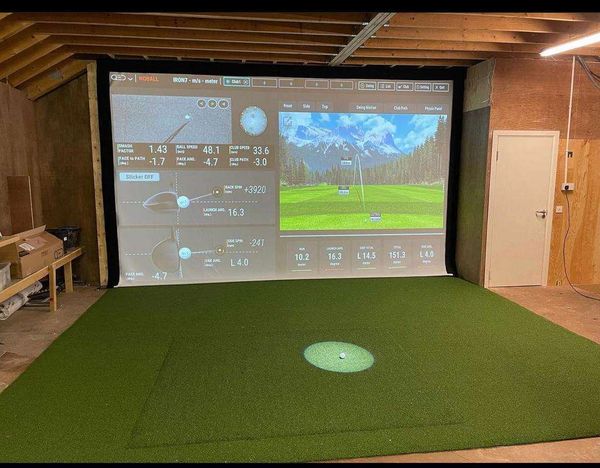
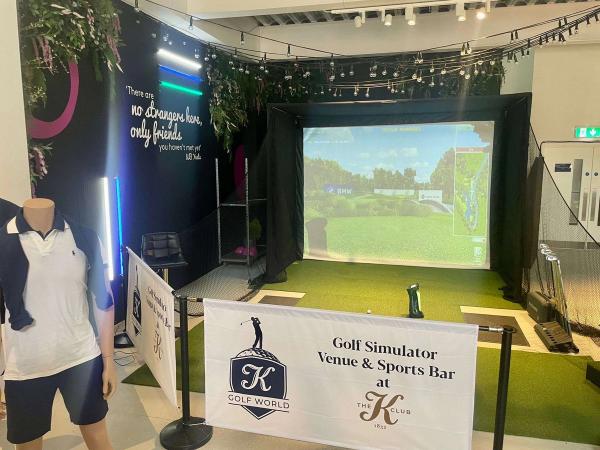
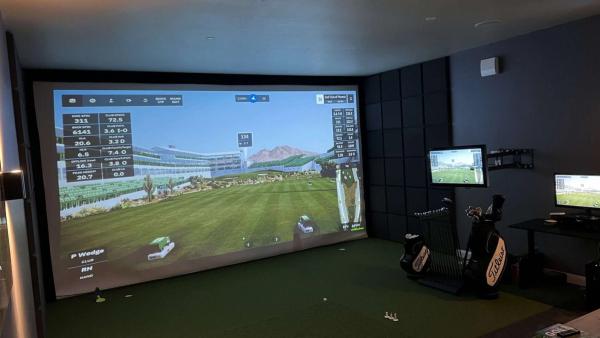
Before you start comparing launch monitors, impact screens or software packages, there is one question that trumps all others: is your room big enough? It might not be the most exciting part of planning a golf simulator, but room dimensions determine everything that follows — the equipment you can use, the screen size you can fit, and ultimately how enjoyable the experience will be once it is built.
We have surveyed hundreds of rooms across Ireland, from single garages in housing estates to purpose-built garden studios. Some were perfect. Others needed minor adjustments. And a few, unfortunately, were just too small. This guide will give you the honest numbers so you can assess your own space before spending a cent.
The Minimum Dimensions
Every simulator installation is different, but after years of designing and fitting systems, we always come back to the same baseline figures:
Minimum room dimensions for a golf simulator: 3 metres wide × 2.8 metres high × 5 metres long. These are the absolute minimums — anything less and you are either compromising safety or making the experience frustrating enough that the simulator will gather dust.
Let us break each dimension down and explain why it matters.
Ceiling Height — The Most Critical Measurement
If there is one dimension that kills more simulator dreams than any other, it is ceiling height. You need a minimum of 2.8 metres (roughly 9 feet 2 inches) from floor to ceiling, and ideally 3 metres or more.
Why is height so important?
Think about your full swing with a driver. At the top of your backswing, the club head reaches its highest point. For a golfer of average height (around 5 foot 10), the club head will be approximately 2.5 to 2.6 metres above the floor at the peak of the swing arc. That leaves almost no clearance in a standard 2.4-metre (8-foot) ceiling room.
There is more to it than just the club arc, though:
- Overhead launch monitor sensors — units like the Uneekor EYE XO2 or Foresight GCHawk mount above the hitting area and need at least 15–20 cm of clearance between the bottom of the unit and the top of the swing arc.
- Lighting and projector mounts — recessed or flush-mounted lighting is ideal, but any hanging fixtures or a ceiling-mounted short-throw projector will reduce your effective height.
- Comfort and confidence — even when the numbers technically work, golfers swing more naturally in a room that feels open above them. We consistently find that customers with 3-metre-plus ceilings enjoy their simulators more and use them more often.
If your ceiling is between 2.6 and 2.8 metres, all is not necessarily lost. Shorter golfers may be fine, and some creative solutions — like lowering the floor slightly or removing a suspended ceiling to expose the joists above — can gain the centimetres you need.
Width — Room to Swing Comfortably
The minimum width we recommend is 3 metres (about 10 feet). This provides enough space for a right-handed or left-handed golfer to stand centrally and swing without worrying about clipping a wall on the follow-through.
What does width affect?
- Screen and enclosure size — most standard simulator screens are between 2.5 and 3 metres wide. You need the screen itself plus a few centimetres on each side for the enclosure frame and wall clearance.
- Side netting or padding — if you plan to have side nets or foam padding (which we strongly recommend for safety), allow an extra 10–15 cm on each side.
- Multiple users — if you want a friend or coach to stand alongside and watch, or if you want to place seating to one side, 4 metres or wider is far more comfortable.
Width is usually the easiest dimension to work with because most garages and rooms meet or exceed 3 metres. It is rarely the deal-breaker.
Depth (Length) — Projector Throw and Ball Flight
We recommend a minimum depth of 5 metres (around 16 feet 5 inches) from the back wall to the impact screen. This measurement is driven by two main factors:
Projector throw distance
If you are using a standard or short-throw projector mounted on the ceiling behind the golfer, it needs a certain distance from the lens to the screen to produce a large, focused image. Ultra-short-throw (UST) projectors can reduce this requirement significantly.
Golfer standing position and ball flight
The golfer needs to stand roughly 2.5 to 3 metres back from the impact screen. This gives the ball enough distance to be read by the launch monitor before it hits the screen.
In total, that means: 1 metre behind the golfer + 1 metre for the stance and mat + 3 metres from ball to screen = 5 metres minimum. More space is always better.
Real-World Examples
Theory is useful, but most people want to know whether their specific space will work. Here are the most common scenarios we encounter:
Single garage
A typical single garage in Ireland measures roughly 3 metres wide by 5.5 to 6 metres deep with a ceiling height of 2.4 metres. The width and depth are usually fine, but the ceiling height is almost always too low.
Double garage
Double garages are the sweet spot for home simulators. A typical double garage is 5 to 6 metres wide by 5.5 to 6 metres deep, giving you more than enough width for a generous screen, side netting, seating, and even a small bar area.
Spare room or basement
Spare bedrooms are almost always too short on ceiling height (2.4 metres is standard in Irish homes). Basements, on the other hand, can be excellent if they have been built with higher ceilings.
Garden studio or purpose-built room
This is increasingly the most popular option we see. A purpose-built garden room gives you complete control over dimensions. We typically recommend building to at least 4 metres wide by 3 metres high by 6 metres deep.
How to Measure Your Space
Before you contact us (or any installer), take the following measurements yourself. It will save time and let us give you a much more accurate initial assessment:
- Ceiling height — measure from the finished floor to the lowest point of the ceiling in the hitting area. If there are beams, light fittings, or ducting, measure to those.
- Width — measure wall to wall at the narrowest point. Note any radiators, shelving, electrical panels, or other obstructions that reduce usable width.
- Depth — measure from the wall where the screen will go to the opposite wall.
- Door and window positions — note where doors and windows are, as these affect screen placement and projector mounting.
- Power sockets — note existing socket locations. A simulator typically needs 3 to 4 sockets (projector, PC, launch monitor, lighting), ideally on a dedicated circuit.
A quick sketch with dimensions, even on the back of an envelope, is incredibly helpful for an initial consultation.
What If My Room Is Smaller?
If your space falls short of the minimums, you still have options — they just involve trade-offs:
- Putting and chipping only — if your ceiling is under 2.6 metres, you could set up a putting and short-game simulator. These require far less height and can work in spaces as low as 2.2 metres.
- Modify the space — removing a suspended ceiling, lowering the floor, or even raising the roof on a garage can be cost-effective ways to gain the height you need.
- Compact equipment choices — a floor-mounted launch monitor like the Garmin Approach R10 or FlightScope Mevo+ does not eat into your ceiling height the way an overhead unit does.
- Net-only setup — if the room is too small for a projector, you can still use a hitting net with a launch monitor and view your data on a tablet or TV mounted to the side.
The worst outcome is spending thousands on a setup you do not enjoy using because the room is not quite right. A few honest measurements up front can save you a lot of frustration and money down the line.
Get Expert Advice on Your Space
Every room is different, and what looks impossible on paper sometimes works brilliantly with the right design — and vice versa. If you are unsure whether your space will work, send us your measurements and a few photos. We will give you an honest assessment, recommend the right equipment for your dimensions, and help you avoid expensive mistakes.